SIGNAL PROCESSING DESIGN HOUSE
From signalarchitecture toverified hardware.
RFSoC · FPGA · DSP · AI/ML
Apexia helps technical teams design, implement and validate high-performance RFSoC, FPGA and DSP systems when schedule, integration and technical risk are tightly coupled.
ASSUMPTIONSIN WRITING
SOURCEREVIEWABLE
EVIDENCEMEASURED
ACCESSENGINEERS, DIRECT
AT EVERY DELIVERY GATE
ARCHITECTURE[ 01 ]
Explicit assumptions and performance bounds
IMPLEMENTATION[ 02 ]
Reviewable FPGA, DSP and host software
INTEGRATION[ 03 ]
Interfaces closed across the complete signal chain
VERIFICATION[ 04 ]
Reproducible test methods and measured evidence
WHERE WE ENTER
Bring us the constraint that is holding the system back.
01
ARCHITECTURE
De-risk the decision before it becomes hardware.
Trade studies, performance budgets, design reviews and platform selection, with assumptions stated in writing and recommendations your team can defend.
- Architecture trade studies
- Coherence and timing budgets
- Independent design reviews
02
IMPLEMENTATION
Turn the model into deterministic signal processing.
Fixed-point DSP, FPGA firmware, RFSoC integration and host-side pipelines, developed against verification harnesses from the start.
- VHDL and Model Composer
- RFDC and MTS integration
- CUDA and high-rate ingest
03
INTEGRATION
Close the interfaces that divide specialist teams.
Bench-level ownership across clocks, converters, programmable logic, software, PCB, thermal design and test, so the complete system behaves as designed.
- Cross-domain debug
- Target-hardware bring-up
- Documented acceptance evidence
TECHNICAL DEPTH
One team across the interfaces.
RFSoC platform engineering
RFDC configuration, converter clocks, MTS, coherent multi-channel ingest
Deterministic DSP
Channelization, DDC, NCO and DDS, beamforming, fixed-point architecture
High-rate software
Data movement, capture, CUDA processing, control paths, system telemetry
Physical integration
Mixed-signal hardware, enclosures, thermal design, environmental planning
ENGINEERING THAT COMPOUNDS
Repeated problems become reusable capability.
Apexia.Fabric
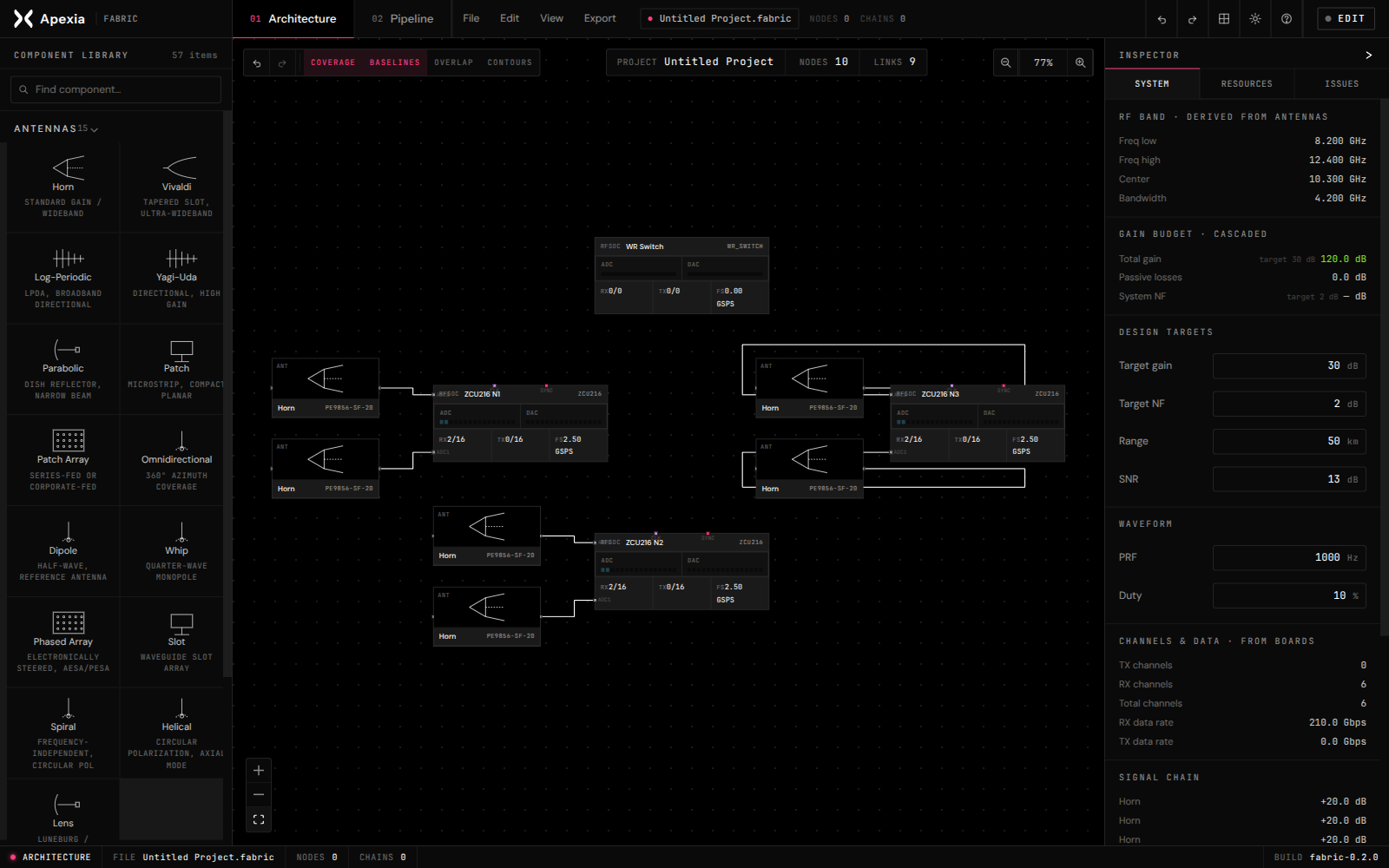
A visual RF system design environment for building, simulating and deploying RFSoC signal chains. Fabric connects early architecture work to generated implementation artifacts.
BLOCK TYPES101
CATEGORIES11
VIRTUAL INSTRUMENTSBEFORE HARDWARE
CODE GENERATIONSDR AND RFSoC
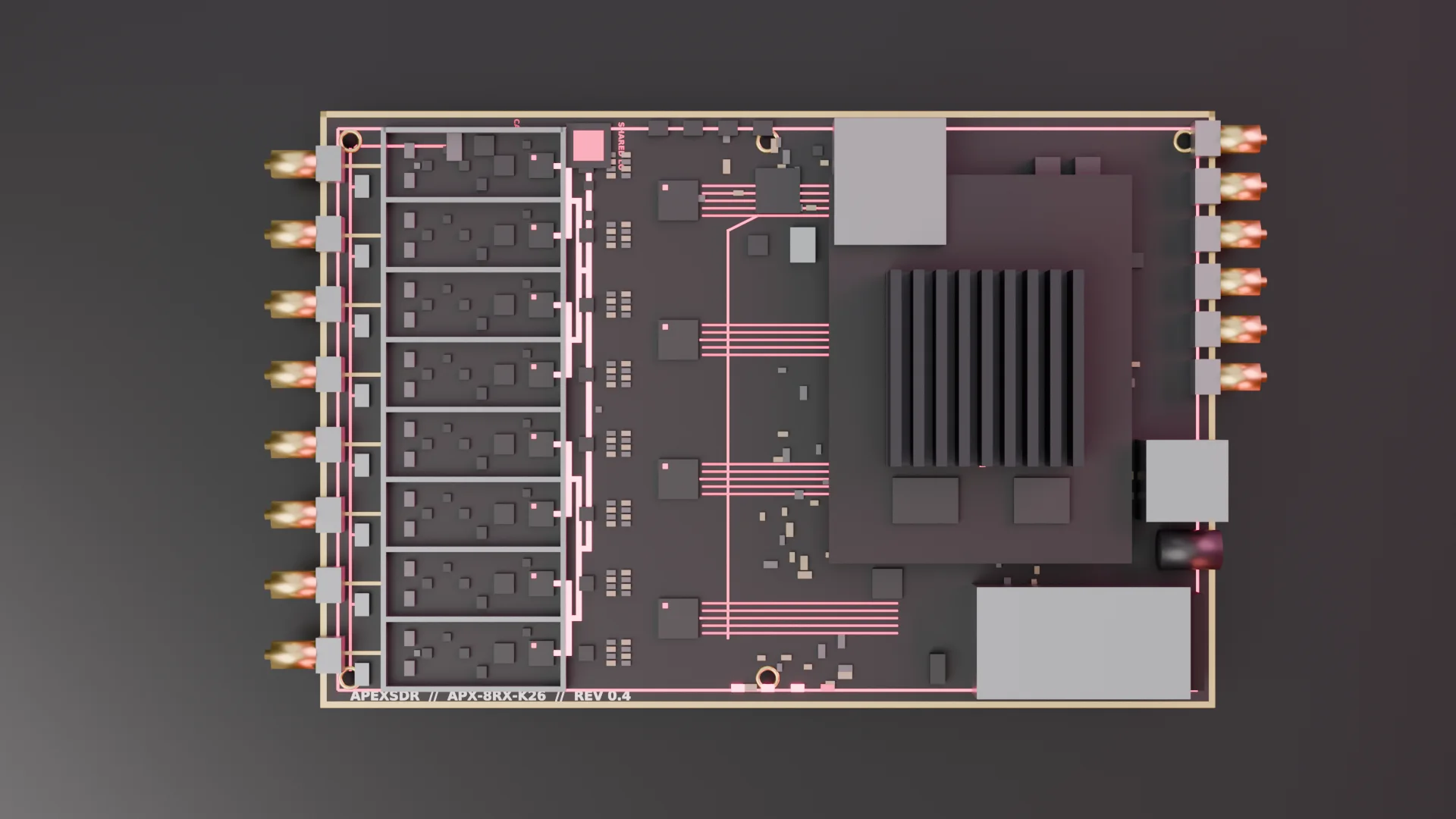 APEXSDR[ EARLY ACCESS ]
An eight-channel coherent wideband SDR for deterministic acquisition, high-rate offload and multi-board expansion to 32 channels.
REVIEW THE PLATFORMCOHERENT RX
IBW / CHANNEL
+11.3 dB
Mean SNR improvement from AI-based denoising on held-out QPSK and 8-PSK windows at 3 to 10 dB input SNR. Research, not a shipping product.
FROM IDEA TO MVP
Want to build an MVP?
We take products from idea to a working MVP: software, AI and hardware, with RF, FPGA and signal processing as our specialty. Every inquiry is answered by the engineers who will do the work.
01 SCOPEDONE
02 ARCHITECTDONE
03 BUILDDONE
04 TESTDONE
05 MVPREADY
WHAT LEAVES THE BENCH
A system your team can own.
SOURCE
Reviewable implementation structured for client ownership
HARNESSES
Bit-true models, simulations and automated checks
EVIDENCE
Measured results tied to a stated test method
DOCUMENTATION
Interfaces, assumptions and operating procedures
START WITH THE CONSTRAINT
What must be trueat your next gate?
PALM BAY, FLORIDA · 28.0345° N 80.5887° W
CLARITY BEYOND THE NOISE