PLATFORM FIELD GUIDE
Gen 3 RFSoC on an academic budget
RFSoC 4x2 field guide.
The RFSoC 4x2 puts a Gen 3 RFSoC (four 5 GSPS ADCs and two 9.85 GSPS DACs) on a board priced for universities and research groups, with first-class PYNQ support. It has become the default platform for academic SDR, radio astronomy prototyping, and anyone who needs real direct-RF hardware without a program budget. This guide covers the board, the two ways to develop on it, and how to run it continuously without cooking it.
AT A GLANCE
At a glance.
- DEVICE
- Zynq UltraScale+ RFSoC ZU48DR (Gen 3)
- RF-ADC
- 4 channels · 14-bit · 5 GSPS (SMA)
- RF-DAC
- 2 channels · 14-bit · 9.85 GSPS (SMA)
- CLOCKING
- On-board LMK04828 + LMX2594
- HIGH-SPEED I/O
- QSFP28 cage (up to 100G) · USB 3.0
- SOFTWARE
- PYNQ image standard; full Vivado/Vitis supported
- COMMUNITY
- PYNQ + CASPER ecosystems
ARCHITECTURE
Architecture in brief.
The ZU48DR carries the same Gen 3 converter technology as the flagship parts; the 4x2 simply bonds out fewer channels and clocks the ADCs at 5 GSPS. Four phase-coherent ADCs is exactly the shape of a direction-finding array, a small interferometer, or a multi-band monitoring receiver, which is why the board shows up in so many research programs.
Development runs on two rails. The PYNQ image gets you from power-on to captured samples in an afternoon: Jupyter notebooks, Python drivers for the data converters and clocks, community overlays. Bare-metal Vivado/Vitis development uses the identical silicon flow as the ZCU111/216, so designs prototyped here migrate up the family with the RF plumbing already understood.
BRING-UP
Bring-up: where the time goes.
01
Two flows, two mental models
PYNQ's Python clock and RFDC drivers configure the LMK/LMX parts for you; a custom Vivado design must own that configuration itself. Teams migrating from notebooks to production bitstreams routinely lose a week rediscovering clock programming the image had been doing silently.
02
MTS on four channels is still MTS
Phase coherence across the four ADCs needs the same SYSREF-driven synchronization procedure as the big boards. If your application is DF or beamforming, verify per-channel phase after every cold start, not once.
03
Thermals under sustained capture
The stock heatsink-fan is sized for bench duty cycles. Continuous wideband capture (the radio-astronomy and monitoring use cases) wants managed airflow, which is precisely why we build a 1U enclosure for this board.
04
Getting data off the board
Four ADCs at rate produce far more than USB or 1G Ethernet can carry. Sustained instruments need the QSFP path into the fabric. A 100G streaming pipeline is its own design task, and sizing it early shapes the whole architecture.
DEPLOYMENT
Racking it.
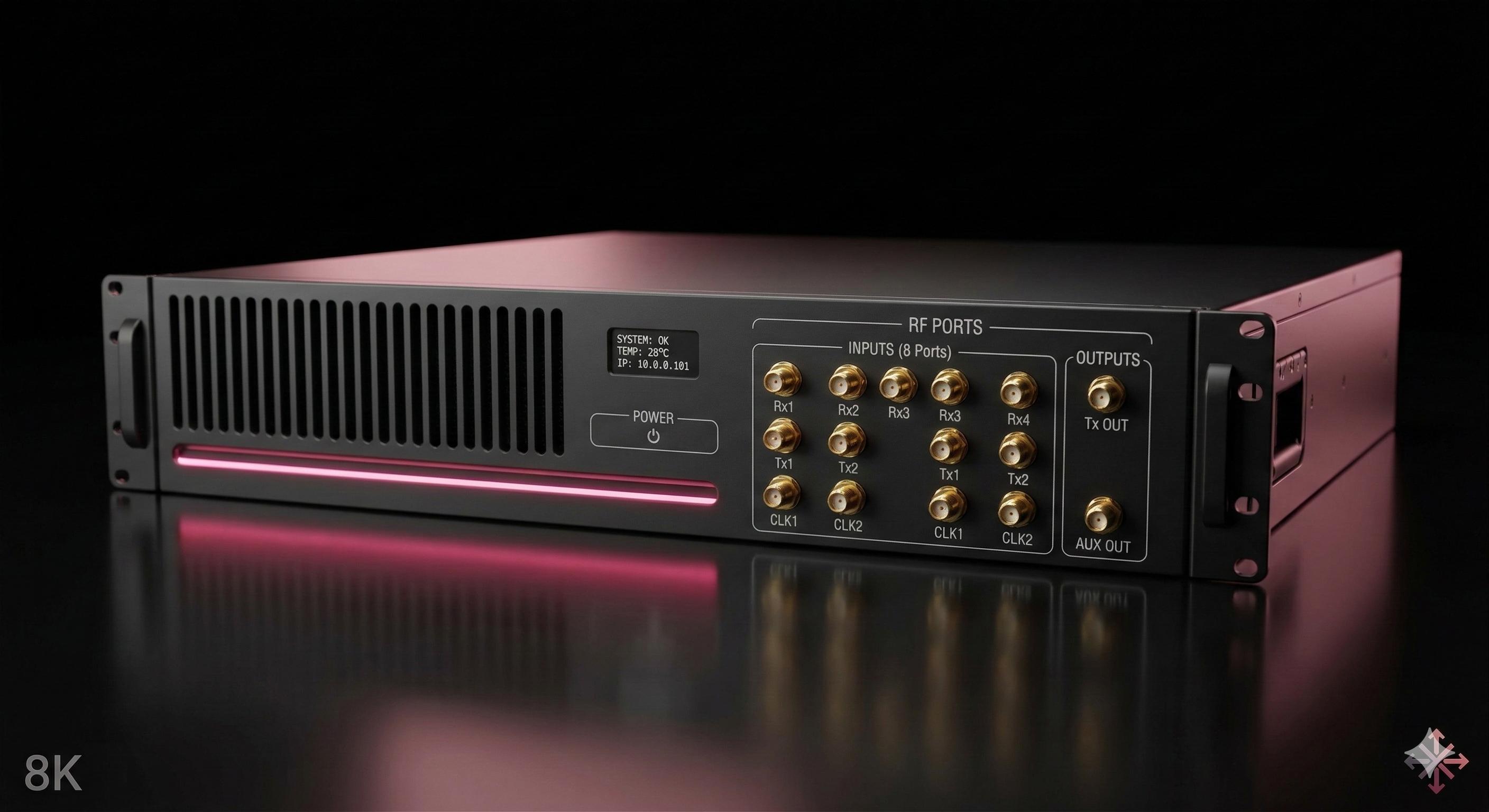
RFSoC 4x2 Enclosure
Research deployments run for months, not minutes. Our 1U rackmount enclosure gives the 4x2 managed airflow for continuous operation, front-panel RF and QSFP access, and a form factor that racks alongside the rest of the instrument.
BUILDING ON IT
Building on it.
Our DSP cores target the 4x2 directly (DDC and decimation chains, polyphase channelizers, and MTS-aware coherent ingest), and the CASPER toolflow service covers this board for instrument-scale acquisition work.
For teams building detection or direction-finding systems on the 4x2, the same bench that builds our cores takes on custom firmware, GPU post-processing, and the mechanical/thermal integration around the board.
FROM THE BLOG
Further reading.
RFSoC BRING-UP AND DEPLOYMENT
Running aRFSoC 4x2program?
PALM BAY, FLORIDA · 28.0345° N 80.5887° W
CLARITY BEYOND THE NOISE