IN DEVELOPMENT · EARLY ACCESS OPEN
Eight coherent channels.Zero integration project.
A wideband coherent receiver where phase alignment is a property of the hardware; not a months-long systems project.
One box. Eight coherent channels.
Eight shielded RF slices, fed by one shared LO.
120 × 180 mm · Kria K26 compute · 40GbE out.
SPEC READOUT
Target specifications.
COHERENT RX
IBW / CHANNEL
MULTI-BOARD
- CHANNELS
- 8 coherent RX
- INSTANTANEOUS BW
- 100 MHz per channel
- RESOLUTION
- 14-bit
- FREQUENCY RANGE
- 300 MHz to 6 GHz · bypass path below
- BACKHAUL
- 40GbE QSFP+ · 1GbE management
- COHERENCE
- Shared LO · auto re-cal on retune
- MULTI-BOARD
- REF / LO / PPS chaining; to 32 channels
- TIMING
- OCXO · ext 10 MHz · 1PPS · VITA 49.2
THE BOARD
The layout is the datasheet.
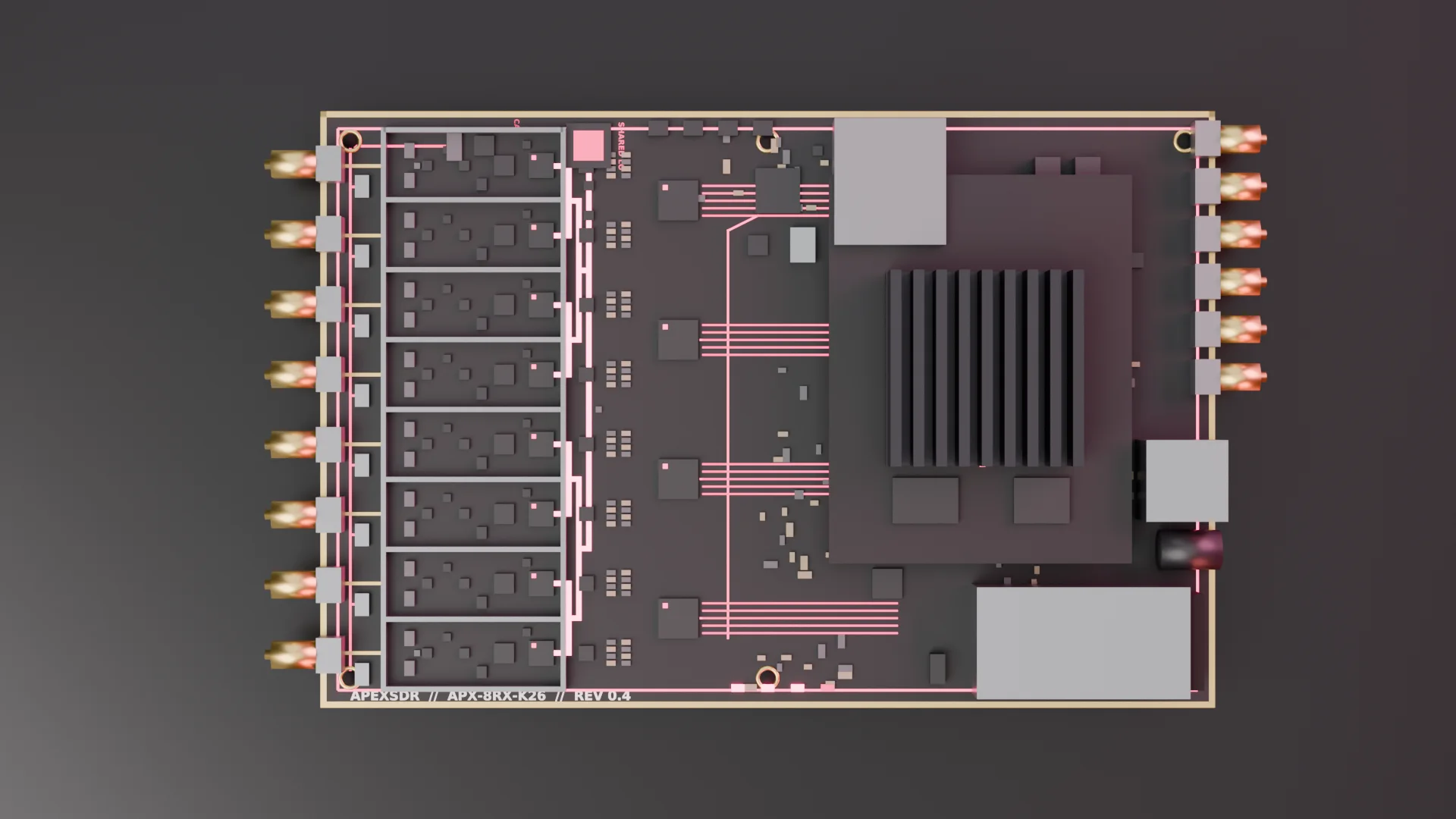
- Shared-LO backbone; one synthesizer, eight demodulators
- Cal injection network; matched-length, pre-LNA
- RF slices: SMA to zero-IF, one shielded lane per channel
- Compute: Kria K26, quad ADC row, 40GbE out
COHERENCE
Aligned at the connector, not in your codebase.
MULTI-BOARD
And it scales by cable.
Multi-box phase coherence is normally where coherent-array budgets go to die. ApexSDR carries reference, LO, and PPS in and out natively: chain boards with SMA jumpers and the stack behaves as one instrument. Thirty-two coherent channels is a parts order, not a program.
SOFTWARE
Ships with Apexia Fabric.
Apexia.Fabric
Fabric is built by the same bench that ships our DSP cores; the pipelines are the product, not a demo.
DEPLOYMENTS
Built for.
Research instrumentation & radio astronomy
Direction finding & TDOA
Spectrum monitoring
RF emitter detection
FOUNDING INSTRUMENTS
First units go to founding instruments.
Research groups and teams who want eval hardware with white-glove bring-up from the engineers who built it. Join the list, or if you're building an instrument now, talk to us directly.
PALM BAY, FLORIDA · 28.0345° N 80.5887° W